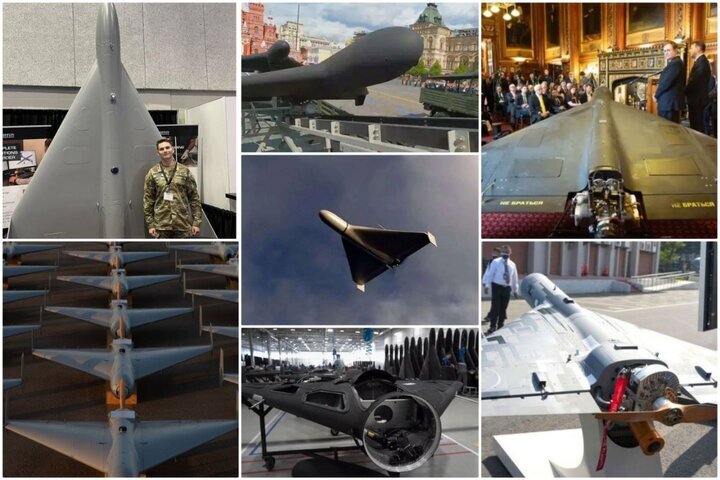
In a global arms landscape dominated by major powers such as the United States, China, and Russia—each traditionally regarded as leaders in military innovation—the Iranian Shahed-136 loitering munition has emerged as a disruptive force. Compact, low-cost, and engineered for operational effectiveness rather than technological spectacle, the drone has redefined the economics and strategy of modern warfare. Its rapid ascent from a locally built platform to an international reference point has compelled the world’s top military industries to pursue direct imitation, signaling the extent to which Iranian innovation has altered strategic calculations.
At the center of this shift is the Shahed-136’s design philosophy. Powered by a simple 50-horsepower piston engine, capable of carrying a 40-kilogram warhead, and able to travel roughly 2,000 kilometers, the system embodies an approach where affordability and reliability matter more than complexity. Estimated to cost between $20,000 and $50,000 per unit, it presents an operational challenge that expensive air-defense networks struggle to counter. This asymmetry—low production cost against high interception cost—has placed Iran in a unique position within global drone warfare.
The most striking indicator of the Shahed-136’s impact is its adoption and replication by the very powers that once dismissed Iran as a secondary or peripheral actor. The United States, long committed to an “invented-here” doctrine, has introduced its own reverse-engineered version through the Pentagon’s “Scorpion Strike” task force. With a reported price point similar to the Iranian model and optimized for swarm coordination, the new system highlights a significant shift: even Washington’s broad technological ecosystem has encountered limitations when facing the cost-effective threat the Shahed poses.
Russia, already recognized as one of the world’s most sophisticated drone developers, has incorporated Iranian innovations into its “Geran-2” version. Enhancements—including improved engines, radar-evading materials, AI-assisted swarm behavior, and advanced anti-jamming antennas—reflect Moscow’s need to adapt the platform to the layered air-defense environment of the Ukraine battlefield. Despite Russia’s extensive domestic UAV programs, the Shahed model fills a gap in its arsenal: a cheap, expendable, long-range attack system capable of overwhelming Western defenses.
China has entered this trend as well. Testing of the Long M-9 drone, whose delta-wing structure and mission profile bear clear resemblance to the Shahed, illustrates Beijing’s recognition that mass-produced, cost-efficient loitering munitions are increasingly central to future conflict scenarios. With similar payload capacity and extended flight endurance, the Chinese platform mirrors an Iranian template that has proven difficult for advanced militaries to ignore.
Together, these cases reveal a deeper contradiction at the heart of global defense innovation: states with enormous military budgets remain constrained by institutional inertia, lengthy procurement cycles, and high production costs. Meanwhile, Iran—shaped by sanctions and compelled to prioritize self-reliance—has developed a model that privileges functionality, scalability, and battlefield practicality.
The Shahed-136 has thus become more than a drone; it is a demonstration of how strategic necessity can outperform financial advantage.
The widespread replication of the system underscores a broader evolution in modern warfare. As accessible drones proliferate, the economics of conflict are being reorganized around volume rather than sophistication. The Shahed-136’s ability to saturate air-defense systems forces adversaries to expend costly interceptors, challenging long-standing assumptions about technological superiority and battlefield deterrence.
Ultimately, the rise of the Shahed-136 highlights a fundamental truth: innovation is not exclusively the domain of the wealthiest states. In this case, Iran has transformed resource constraints into an advantage, developing a platform that powerful militaries around the world now study, reverse-engineer, and adapt. The result is a shift in the global balance of UAV development—one that positions Iranian engineering as a reference point in the next generation of asymmetric warfare.
Source: Mehr


