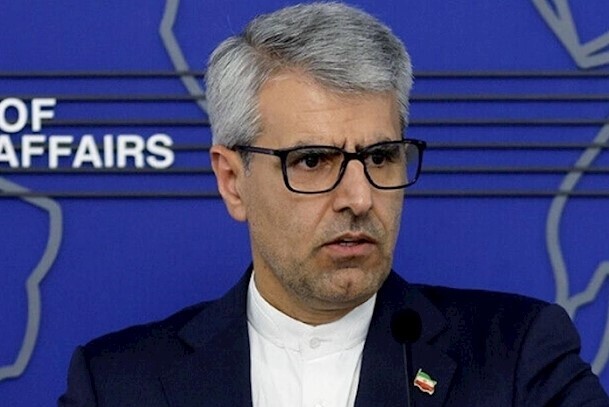
The spokesperson referenced the UN General Assembly resolution from August, stating that December 4th is designated as the International Day Against Unilateral Coercive Measures and Unilateral Sanctions. He noted that this designation reflects the international community's concern over the use of coercive methods by some countries to advance their goals.
Baghaei also addressed the ongoing crimes committed by the Zionist regime in Gaza and the West Bank, reporting that approximately 400 people have been martyred in the area since the ceasefire. He expressed hope that the international community would take decisive action as soon as possible to halt the Zionist regime’s crimes and aggressions in the region.
U.S. National Security Document and Israeli Agenda
Responding to a question regarding the recently published U.S. National Security Document, the Foreign Ministry Spokesperson stated that Iran will certainly review the document. However, he noted that the initial observation reveals that the document "starkly exposes the reality of the actions" taken by various U.S. administrations under the guise of human rights and democracy around the world.
Baghaei continued that the document's content effectively places the U.S. in the position of a judge over all countries worldwide. He highlighted that the document makes no mention of Palestinian rights and asserted that, regarding West Asia, the document is less about U.S. national security and more a "national security document for the Zionist regime," focusing entirely on imposing the regime's dominance in the region. This, he argued, signifies U.S. complicity in the continuation of the Zionist regime's crimes in the region.
He pointed to the inclusion of the possibility of attacking Iran's nuclear facilities in the document, calling this further proof of the U.S.’s international responsibility regarding this international transgression.
Unwavering Sovereignty Over Iranian Islands
Addressing the continued insistence by the Persian Gulf Cooperation Council (PGCC) on repeating claims regarding the three Iranian islands and the reactions from the Foreign Ministry and Ali Akbar Velayati, Baghaei was unequivocal. He stated: "Our position is clear. Historically, legally, and factually, there is no doubt or ambiguity about Iran's sovereignty over the three islands."
He reiterated that the PGCC statement is a repetition of past claims that Iran absolutely does not accept. He added that the reaction of Iranian personalities, media, and politicians to issues related to national sovereignty and Iran's territorial integrity is natural, as every Iranian is sensitive to this matter. Baghaei advised the countries involved to ensure that their statements and stances do not "play into the hands of the region’s primary enemy, the Zionist regime."
Baghaei affirmed that Iran is consistently committed to friendship and good neighborly relations with all neighboring countries and will continue this approach while unequivocally defending its national sovereignty and territorial integrity with authority.
No Interference in Lebanon and Readiness for Dialogue
In response to a question regarding reports that the Lebanese Foreign Minister had rejected an invitation from Araghchi and claimed Hezbollah is subordinate to Iran, Baghaei strongly denied any interference. "The discussion of Iranian interference in Lebanon's affairs is entirely a distractive argument. We have no interference in Lebanon's internal affairs," he stated. He added that Hezbollah is an integral, influential, and deep-rooted entity within Lebanon and the international community and makes its own decisions regarding its policies and conduct.
He clarified that Iran's concern for peace and security in the region and its condemnation of the Zionist regime’s threats do not constitute interference in the internal affairs of Lebanon or any other country; rather, this reflects Iran's sense of responsibility. Baghaei stressed that Iran is "fully ready for dialogue" with Lebanese officials on bilateral relations, noting that diplomatic relations are maintained and the new Lebanese Ambassador has recently been stationed in Tehran. He emphasized that decisions regarding Lebanon's internal issues, including its defense strategy, must be made through Lebanese-Lebanese dialogue, and the issue of resistance weapons is a matter for Lebanon and Hezbollah to decide.
Critique of Germany and E.U.
Commenting on the U.S. National Security Document mentioning the lack of freedom of expression in Europe and Germany's anger over the position, Baghaei remarked on the irony. He suggested advising these countries: "Do not wish upon others what you do not wish upon yourselves." He noted that German and European interventions in the internal affairs of other countries, including Iran, are clear, but they appear unwilling to accept similar actions against themselves.
IAEA Contacts and Regional Diplomacy
Regarding Iran's relationship with the IAEA and the role of third-party countries, the spokesperson stressed that the Islamic Republic's contacts with the International Atomic Energy Agency continue normally through customary channels. He explained that as a member of the IAEA and the NPT, Iran maintains continuous direct contact with the Agency's management, mainly through its mission in Vienna. While noting that it is natural for other parties to raise this topic in bilateral talks with the Director-General, Baghaei stressed: "However, to say that mediation or negotiation in the conventional sense is underway, no. As I mentioned, our contacts with the Agency continue normally through customary channels."
Responding to a question about Araghchi's recent phone conversation with his Egyptian counterpart regarding the nuclear issue, Baghaei clarified that the call primarily centered on bilateral relations and consultations on regional developments. He noted that regional developments are genuinely concerning. He confirmed that during the call, it was agreed to schedule a new round of political consultations between Iran and Egypt, which will take place soon. He also acknowledged that Egypt is one of the parties that have exerted their good offices in relation to the nuclear issue, and Iran appreciates the efforts of Egypt and other countries involved.
Upcoming Travel and Communication Channels
Baghaei announced that President Pezeshkian will travel to Turkmenistan and Kazakhstan in the coming days. Additionally, Foreign Minister Araghchi will visit Belarus and Russia in the coming weeks for meetings and consultations with officials from both countries.
Finally, the Foreign Ministry Spokesperson confirmed that the official communication channel between the Islamic Republic of Iran and the United States is maintained through the interests sections of the two countries—the U.S. Interests Section in Tehran, managed by the Swiss Embassy, and Iran's Interests Section in Washington. He clarified that while it is common for other countries or regional officials to convey messages, "there is no direct channel between Iran and the United States."
No Mediation Required in Iran-IAEA Relations
The Foreign Ministry Spokesperson, in response to another question on whether the Egyptian Foreign Minister's phone conversation with Mr. Grossi suggests Egypt is playing a mediating role between Iran and the International Atomic Energy Agency (IAEA), reiterated that Iran maintains a direct relationship with the Agency and its representation in Vienna is active. Therefore, he stated, there is no need for mediation in the conventional sense in the relationship between Iran and the IAEA. Baghaei added that, as previously mentioned, Egypt and certain other countries are attempting to assist the process, and the recent phone conversation took place from this perspective.
Iranian Nationals Returning from the U.S. Due to Harassment
In response to news about the return of a number of Iranians from the U.S. based on new Washington migration policies, the Foreign Ministry Spokesperson said that the American side claims this action is taken for legal reasons and violations of the country's immigration laws. He noted that in the past year, racist actions by the U.S. government against citizens of various countries, including Iran, have intensified, and Iranian nationals have been harassed under different pretexts.
He highlighted that this is the second group of Iranians being returned to the country. The senior Iranian diplomat noted that after the pressures exerted by the U.S. on these Iranian citizens, they referred to the Iranian Interests Section in Washington and expressed their desire to return home. He affirmed that every Iranian is free to return to the country, and the Interests Section has provided the necessary arrangements, with the individuals expected to return in the coming days.
Baghaei stated that their number is between 50 and 55 people, adding that reports indicate over 500,000 nationals of various countries have been returned to their home countries or other nations by the U.S. under different pretexts in the past year. He stressed that political motivations are involved in the pressure exerted on Iranian nationals, and these migratory pressures are contrary to international laws.
Iran's Efforts to De-escalate Tensions Between Afghanistan and Pakistan
The Iranian Foreign Ministry Spokesperson also addressed the close ties between Tehran, Afghanistan, and Pakistan, emphasizing the Islamic Republic's efforts to reduce tensions between the two neighbors. Baghaei stated that Iran shares cultural, historical, and religious proximity as well as common borders with both countries, cautioning that "any insecurity on the surrounding borders will certainly be detrimental to our national security."
He added that since the very first days of the tension, the Foreign Minister contacted the relevant Pakistani and Afghan officials, announcing Iran's readiness to provide any assistance to reduce tension and resolve disputes through dialogue.
He affirmed that this is an ongoing process and Iran maintains contact with both sides. Baghaei noted that the issue was raised during the recent visit of Dr. Larijani to Pakistan and was emphasized in telephone and in-person conversations with Afghan officials. Iran is also consulting with its regional partners to find a solution to reduce this tension by utilizing existing capacities and the shared concern of regional countries regarding the dispute between Afghanistan and Pakistan.
U.S. Attempts to Interfere in Iran's Affairs
Responding to a question regarding recent statements by Tom Barrack, the U.S. Special Envoy for Syria and Lebanon and Ambassador to Turkey, claiming that the U.S. has attempted to change the regime in Iran twice but failed, and that Trump is ready for "real dialogue" with Iran, the Foreign Ministry Spokesperson stated that it is very clear that various U.S. administrations have constantly sought to interfere in Iran's internal affairs over the past five decades. He added that Barrack's comments are, in a sense, an admission of U.S. attempts to violate Iran's national sovereignty. He pointed out that while the U.S. official claimed two attempts, the country has acted repeatedly to harass the Iranian people and interfere in Iran's affairs, and this issue is not limited to the past five decades but has a long history. The Foreign Ministry Spokesperson continued that talking about "real negotiation" for the Americans means nothing more than dictation. The U.S. must change its approach, though he acknowledged that changing habits is difficult, or perhaps even impossible.
No Justification for Threatening Venezuela
The Iranian Foreign Ministry Spokesperson, in response to a question about the increase in U.S. military pressure on Venezuela, reaffirmed Iran's commitment, as a UN member state, to the inherent right of all governments to defend themselves against any external threat or aggression. Referring to recent developments in the Western Hemisphere, Baghaei said that Iran has repeatedly expressed solidarity with Venezuela, emphasizing that what is occurring in the region is an act based on coercion and a clear instance of international bullying, and that "there is no justification or reason for threatening actions and the use of force against that country."
He noted that Iran cooperates and coordinates with Venezuela, China, and Russia at various international and multilateral levels. Venezuela is a leading country in the Non-Aligned Movement and a member of the Group of Friends of the UN Charter in New York. The spokesperson warned that what is happening against Venezuela, if not met with resistance and comprehensive international action, could become the cornerstone of new lawlessness at the global level. Therefore, he concluded, it is the duty of all governments to take a stand against the violation of UN principles and rules, according to ISNA.
On US's new National Security strategy
The spokesperson of Iran's Ministry of Foreign Affairs also commented on the publication of the new US National Security document, saying, “Naturally, we will examine this document. At first glance, it is very candid and openly states everything the US administrations have pursued over the past years. All their concerns in West Asia revolve around access to energy resources and securing Israel."
"From the essence of this document, we can assess that the US positions itself as a judge in the affairs of countries worldwide—a role that no party accepts. This document, more than being a US National Security document, is essentially a security document for the Israeli regime. This, in itself, indicates US complicity in the regime’s crimes," Baghaei underlined.
He stressed that the document’s emphasis on being proud of the attack on Iran’s nuclear facilities clearly demonstrates that the US accepts international responsibility for this assault.


