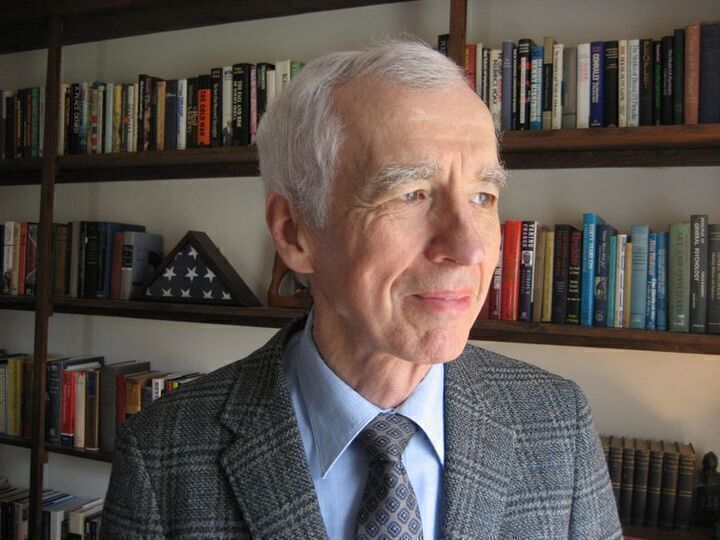
To shed more light on the future of the regional developments, possible Iran-US talks and latest US President's stance towards Iran's nuclear program, TABNAK reached out to Professor Paul Pillar former CIA intelligence analyst
Following is the full text of the interview with him:
Donald Trump stated a few days ago: “Iran is rapidly rebuilding their missile program. They can try, but reviving the nuclear program will take Iran a long time — and if they try to rebuild and revive it without a deal, we will destroy it again. We can also quickly take out Iran’s missiles.” It appears that Trump is talking about a “preventive war” against Iran’s missile program. He has also attacked Iran’s nuclear program (claiming “preemptive war”) by striking the Natanz, Fordow, and Esfahan facilities. What is your assessment of his claim of a preventive war against Iran’s missile program?
Iran's ballistic missile capabilities do get frequently mentioned in discussions in the United States about what policy toward Iran ought to be. Trump does not seem to be currently interested, however, in a new war against Iran. His preferred posture, as reflected in the administration's recently released National Security Strategy, is to say that the Iran problem has been "solved" for now with the attacks in June. A new war, aimed primarily at Iran's missiles, is more likely to be instigated by Israel (see response to question 3, below).
The Trump administration has announced that it will negotiate with Iran only if Iran agrees to zero enrichment, limits its missiles to ranges under 500 km, and stops supporting its proxy forces. In a Foreign Affairs article, Mohammad Javad Zarif wrote that if Tehran and Washington can implement an updated version of the JCPOA, they might be able to address other difficult issues such as regional security, arms control, and counter-terrorism — in other words, he proposes a step-by-step approach. Do you think this approach would be acceptable to the United States?
It would be acceptable as far as U.S. interests are concerned, and the approach outlined by Zarif probably makes the most sense as a feasible formula for any new US-Iranian agreement. As long as Trump is president, however, what he would want to see is an agreement that he could claim is better than the JCPOA (whether or not it actually was any better). So merely an updated version of the JCPOA, without any provisions that Trump could claim had gone farther than the JCPOA, probably would be unacceptable to him.
According to some news sources, Benjamin Netanyahu, the Prime Minister of Israel, plans to raise the issue of a new attack on Iran in his upcoming visit with Trump. Given the current deadlock and the possibility that Iran may revive its missile program — potentially creating a relative balance against Israel —Will Trump authorize another war?
The issue is not one of whether Trump will "authorize" a war but instead whether Israel will again succeed in dragging the United States into a war that it would not otherwise have fought. "Mowing the lawn" is a repeated Israeli approach to using military force against other nations in the region, and it could again apply to Iran, with the missile program being the principal declared target.
Some observers believe Trump is no longer willing to negotiate with Iran unless Tehran accepts all of Washington’s demands. Based on this analysis, Trump does not seek regime change, but rather he wants the agreement on his terms only. Whereas it seems Netanyahu is pushing for regime change and sees the current situation as a golden opportunity for this goal. What is your assessment of this view?
What Netanyahu's government wants is not regime change in Iran but rather using Iran as an all-purpose adversary to blame for anything bad in the Middle East and to distract international attention away from what Israel itself is doing that destabilizes the region. I have seen unguarded comments from Israeli officials that the last thing they would like to see in Iran is emergence of a peaceful liberal democracy, because this would mean Iran would no longer be filling this useful role as an adversary.
Rafael Grossi, Director General of the International Atomic Energy Agency (IAEA), says that inspectors cannot access Iranian facilities damaged by the 12-day war, yet he repeatedly claims that enriched uranium exists in Iran. His focus on something that is not fully verified seems odd, and it appears his goal is to keep the “Iran nuclear threat” alive. What is your assessment of this?
I think Grossi is a person of integrity who is diligently trying to fulfill his responsibilities as head of the IAEA. The enriched uranium did not vanish as a result of the Israeli and U.S. strikes in June. Maybe it is buried and currently inaccessible or maybe it isn't, but that is exactly the kind of question that requires verification based on full Iran-IAEA communication.


