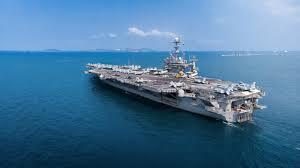
In recent days, the United States has significantly intensified its military posture across the Persian Gulf, the Sea of Oman, and the northern Indian Ocean—reaching one of its highest operational levels in years. This development is unfolding against the backdrop of escalating political and security tensions between Washington and Tehran, alongside rapidly evolving dynamics in West Asia.
According to international reports and publicly available maritime tracking data, the USS Abraham Lincoln (CVN-72), accompanied by support vessels, cruisers, and Aegis-equipped destroyers, has been deployed across the Sea of Oman and surrounding waters. At the same time, the U.S. Air Force has announced multi-day military exercises and operational flights, framing them as efforts to demonstrate “defensive readiness and deterrence.”
While U.S. officials present these maneuvers as a display of hard power aimed at sending clear security signals to Iran and regional actors, Tehran’s response has been layered, calculated, and strategically restrained—yet unmistakably firm.
Full Surveillance of U.S. Movements: A Direct Warning from Iran’s Army Chief
Within this context, Major General Amir Hatami, Commander-in-Chief of the Iranian Army, addressed recent regional developments during the 18th “Ali Akbar (AS)” Festival honoring young soldiers of the armed forces. He emphasized that all hostile movements in the region are being closely and continuously monitored, and that Iran’s armed forces remain at the highest level of readiness.
Hatami warned that any miscalculation by adversaries would inevitably endanger not only their own security but also regional stability—and even the security of the Israeli regime. He further highlighted the unprecedented coordination among Iran’s four army branches and other military components, stressing that the country’s defensive and operational preparedness is at its peak—a position repeatedly echoed by senior commanders of both the Army and the IRGC in recent months.
Aerial Signal Over the Sea of Oman: Iran’s Drone Message
Simultaneously, data released by global aviation tracking platforms drew the attention of military analysts to the flight of an unidentified aerial vehicle bearing the call sign SEP2501 along the Sea of Oman coastline. Unlike routine civilian flights, this mission exhibited distinct intelligence and security characteristics.
In strategic assessments, the flight has been interpreted not as a routine operation but as a practical demonstration of Iran’s intelligence reach—particularly given its proximity to the U.S. carrier strike group operating in the area.
Why the Sea of Oman Matters
The Sea of Oman and the Arabian Sea constitute a critical maritime corridor linking the Persian Gulf to the Indian Ocean and serve as a key artery for global energy transit. The deployment of a U.S. aircraft carrier in this zone is intended to project deterrence and establish a protective umbrella. However, the appearance of SEP2501 underscored a crucial reality: naval and aerial dominance does not automatically translate into absolute information superiority.
Under modern military doctrines, situational awareness does not depend solely on physical proximity. Iran’s long-range reconnaissance drones, equipped with advanced sensors, are capable of collecting electronic and signal intelligence from significant distances—an ability that aligns directly with Tehran’s Anti-Access/Area Denial (A2/AD) strategy.
Electronic Warfare: The Vulnerability of Modern Carriers
Military analysts argue that the primary concern for U.S. naval commanders is not a direct strike, but Iran’s capacity to gather Electronic Intelligence (ELINT). Monitoring and analyzing radar, communication, and data-link frequencies—particularly those associated with systems such as Aegis—could enable Iran to design more effective jamming, deception, or radar-blinding scenarios if required.
Coupled with optical and thermal imaging, secure data links, and resilience against electronic countermeasures, Iran’s drones have emerged as potent tools in information-centric maritime warfare.
Shahed-139 or “Homa”? When Every Vessel Becomes a Potential Launch Platform
Based on available flight patterns and data, some experts speculate that the aircraft belongs to Iran’s family of long-range reconnaissance drones, potentially the Shahed-139 or the vertical takeoff and landing (VTOL) drone known as “Homa.”
VTOL platforms such as Homa do not require conventional runways and can be launched from non-military vessels or discreet platforms—a capability that fundamentally alters maritime security calculations and elevates asymmetric threats to a new operational level.
Tehran’s Strategic Message to Washington
The timing and visibility of the SEP2501 flight convey several clear messages:
One-sided deterrence has failed; the presence of an aircraft carrier does not guarantee informational immunity.
The Sea of Oman is under Iran’s intelligence surveillance, and extra-regional military movements are closely monitored.
The public visibility of flight data on open platforms creates part of a psychological and cognitive strategy—reminding adversaries that U.S. naval assets are not invisible.
The End of Aircraft Carrier Immunity
Recent developments indicate that military competition in West Asia has entered a new phase—one in which intelligent, drone-based, and information-driven technologies are reshaping the balance against massive, high-cost platforms.
As the USS Abraham Lincoln sails through the Arabian Sea with its full combat capabilities, a far smaller yet sophisticated aerial asset quietly feeds critical data to Iranian military analysts. This reality signals a shifting balance of power and highlights the gradual erosion of traditional U.S. naval dominance in regional waters.
Source: Mehr


