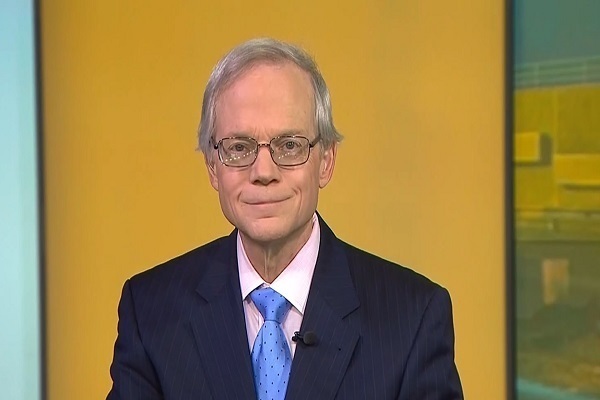
Mark Fitzpatrick, who was Executive Director of the IISS Americas office and head of the Non-Proliferation and Nuclear Policy Programme untile 2019, n an interview with TABNAK talked of the recent developments in Iran and US ties and stances taken by two sides.
Following is the full text of the interview:
Donald Trump stated a few days ago: “Iran is rapidly rebuilding their missile program. They can try, but reviving the nuclear program will take Iran a long time — and if they try to rebuild and revive it without a deal, we will destroy it again. We can also quickly take out Iran’s missiles.” It appears that Trump is talking about a “preventive war” against Iran’s missile program. He has also attacked Iran’s nuclear program (claiming “preemptive war”) by striking the Natanz, Fordow, and Esfahan facilities. What is your assessment of his claim of a preventive war against Iran’s missile program?
President Trump’s talk about attacking Iran’s missiles is a departure from previous policy. Until now, the United States primarily has been concerned about Iran developing nuclear weapons, because of the threat they could pose to US national interests and to global security. Missiles were of lesser concern. Iran’s neighbors have to worry about the missiles that could hit their territory, but the US homeland is far out of range. What has changed is that Israel now sees ballistic missiles as the greatest threat Iran poses, because so many of them were able to penetrate the Iron Dome defense. In talking about taking out Iran’s missiles, Trump seems to be instinctively parroting Netanyahu, wrongly seeing Israel and American national interests as equivalent.
The Trump administration has announced that it will negotiate with Iran only if Iran agrees to zero enrichment, limits its missiles to ranges under 500 km, and stops supporting its proxy forces. In a Foreign Affairs article, Mohammad Javad Zarif wrote that if Tehran and Washington can implement an updated version of the JCPOA, they might be able to address other difficult issues such as regional security, arms control, and counter-terrorism — in other words, he proposes a step-by-step approach. Do you think this approach would be acceptable to the United States?
While I personally believe that Mr. Zarif’s suggestion is the best way forward, I do not think the current US leadership sees much value in a step-by-step approach that does not clearly and quickly lead to accomplishment of US goals. Seeing the US as supremely dominant after the June attacks, the Trump administration does not regard compromises as necessary. But the three goals mentioned are not of equal importance. Zero enrichment is the top priority. Limiting missile ranges and ending support for proxy forces would certainly be good, but they are not as directly relevant to US national interests. So I believe that if Iran were to accept zero enrichment, this would be sufficient to reach a deal.
According to some news sources, Benjamin Netanyahu, the Prime Minister of Israel, plans to raise the issue of a new attack on Iran in his upcoming visit with Trump. Given the current deadlock and the possibility that Iran may revive its missile program — potentially creating a relative balance against Israel —Will Trump authorize another war?
With the obvious caveat that Trump is unpredictable, I do not expect he will bring the US into another round of attacks against Iran. Few Americans would accept the need or justification. Trump’s focus is on the Western Hemisphere where fostering regime change in Venezuela is his top priority. This said, Trump would not try to stop Netanyahu from attacking Iran’s missile program, as long as the US is not directly engaged.
Some observers believe Trump is no longer willing to negotiate with Iran unless Tehran accepts all of Washington’s demands. Based on this analysis, Trump does not seek regime change, but rather he wants the agreement on his terms only. Whereas it seems Netanyahu is pushing for regime change and sees the current situation as a golden opportunity for this goal. What is your assessment of this view?
I think the observers you cite are correct on both accounts: Trump is not interested in negotiations that would require American compromises, and neither is Trump interested in engaging in a campaign of regime change for Iran. Such a policy would exacerbate tensions within his Republican party. Many Trump supporters are increasingly vocal in saying that he should focus more on internal American issues and stop spending so much energy on international matters. Netanyahu, on the other hand, has political reasons for pressing for Iranian regime change, as a distraction from his domestic troubles.
Rafael Grossi, Director General of the International Atomic Energy Agency (IAEA), says that inspectors cannot access Iranian facilities damaged by the 12-day war, yet he repeatedly claims that enriched uranium exists in Iran. His focus on something that is not fully verified seems odd, and it appears his goal is to keep the “Iran nuclear threat” alive. What is your assessment of this?
Director General Grossi must keep pressing for access to Iran’s enriched uranium stockpile because monitoring it is a core function of the IAEA. It is not a contrived issue in order to keep the “Iran nuclear threat” alive. I see no room for doubt that there is enriched uranium in Iran. If the canisters of the product had been destroyed in the June bombing, they would have emitted gas that would have been detected. The Iranian government has confirmed that the enriched uranium stockpile was not destroyed, and Israeli intelligence confirms this. The oustanding question is: where is it?


