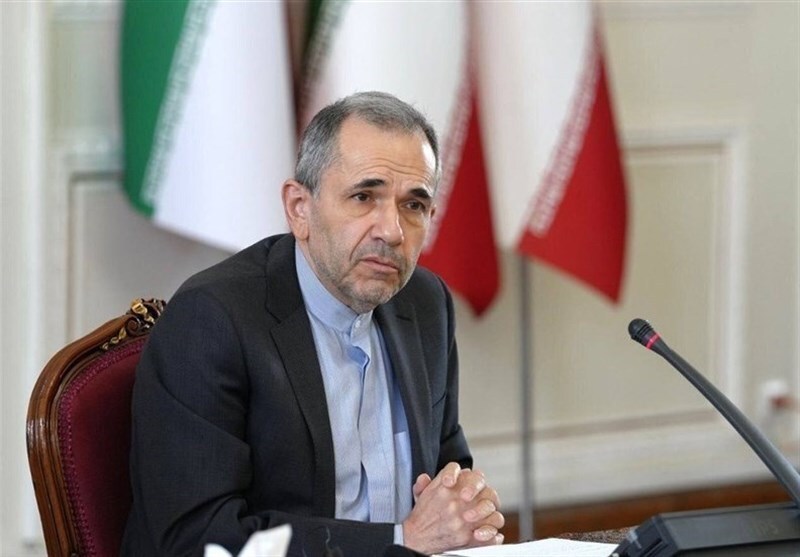
In an interview with BBC in Tehran, Majid Takht Ravanchi confirmed that the second round of Iran-US talks is set to take place in Geneva on Tuesday, saying they had been "more or less in a positive direction but it is too early to judge".
The US and Iran held indirect talks in Oman earlier in February.
Takht Ravanchi said Iran would head to the next round in Geneva with hope that a deal could be done.
"We will do our best but the other side also has to prove that they are also sincere," he said.
He noted that the ball was "in America's court to prove that they want to do a deal", adding, "If they are sincere, I'm sure we will be on the road to an agreement."
The deputy foreign minister pointed to Tehran's offer to dilute its 60%-enriched uranium as evidence of its willingness to compromise.
"We are ready to discuss this and other issues related to our program if they are ready to talk about sanctions," Takht Ravanchi told BBC.
As to whether Iran would agree to ship its stockpile of more than 400 kg of highly enriched uranium out of Iran, as it did in the 2015 nuclear deal, Takht Ravanchi said "it was too early to say what will happen in the course of negotiations".
One of Iran's main demands has been that talks should focus only on the nuclear file, and Takht Ravanchi said, "Our understanding is that they have come to the conclusion that if you want to have a deal you have to focus on the nuclear issue."
Takht Ravanchi said the "issue of zero enrichment is not an issue anymore and as far as Iran is concerned, it is not on the table anymore".
He also reiterated Tehran's refusal to discuss its ballistic missile program with American negotiators.
"When we were attacked by Israelis and Americans, our missiles came to our rescue so how can we accept depriving ourselves of our defensive capabilities," Takht Ravanchi stressed.
The senior diplomat also expressed concern about the American president's conflicting messages.
"We are hearing that they are interested in negotiations," he said. "They have said it publicly; they have said it in private conversations through Oman that they are interested to have these matters resolved peacefully."
"We are not hearing that in the private messages," Takht Ravanchi added, referring to the notes being passed through Oman's Foreign Minister Sayyid Badr bin Hamad Al-Busaidi.
Takht Ravanchi also questioned the US military build-up in the region, warning another war would be "traumatic, bad for everybody… everybody will suffer, particularly those who have initiated this aggression".
He added, "If we feel this is an existential threat, we will respond accordingly." As to whether Iran would regard an American campaign as a battle for survival, he replied, "It is not wise to even think about such a very dangerous scenario because the whole region will be in a mess."
Asked about more than 40,000 US soldiers now being posted in the region, Takht Ravanchi replied "it would be a different game".
"We see an almost unanimous agreement in the region against war," Takht Ravanchi said.
"We are hopeful we can do this through diplomacy, although we can't be 100% sure," he reflected, adding Iran has "to be alert so we are not surprised".


