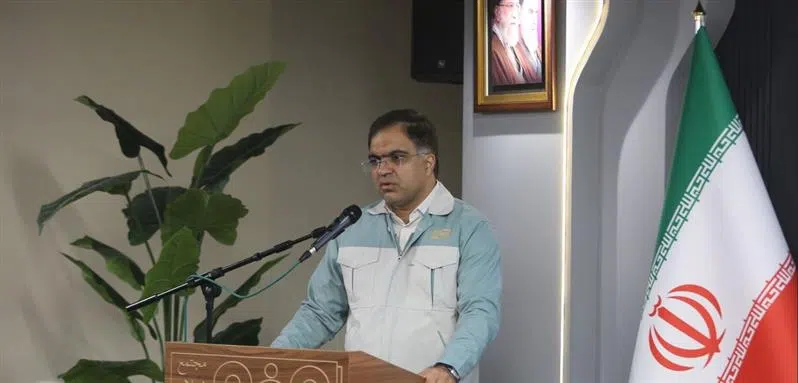
Mobarakeh Steel’s Deputy for Sales and Marketing, referring to the continuation of market supply following the attacks, said that the company resumed production and product supply just one month after the strike and has supplied more than 2.5 million tonnes of products to the market to date. This approach has made maintaining maximum domestic market supply one of the company’s foremost priorities.
According to the Communications Management of Mobarakeh Steel Group, Reza Heydari, Deputy for Sales and Marketing at Mobarakeh Steel, made the remarks during a visit by the secretary and members of the Association of Steel Pipe and Transmission Line Coating Manufacturers to the company’s production lines on Monday, Mehr 6. He said: “We are pleased to host the Association of Steel Pipe and Transmission Line Coating Manufacturers as the first guests of Mobarakeh Steel’s Sales and Marketing Division following reconstruction. We hope that, through joint meetings and working sessions, we can take more decisive and targeted steps toward meeting the maximum needs of actual consumers of various types of steel sheets across the country.”
Two Scenarios for Market Supply Following the Attack
Emphasizing that, following the attack on Mobarakeh Steel, the company’s management, particularly the Sales and Marketing Division, held joint meetings with national officials to prevent any market disruption, Heydari said that the company faced two major scenarios at the time.
Under normal circumstances, Mobarakeh Steel supplies approximately 350,000 to 360,000 tonnes of hot-rolled steel sheets to the market each month, in addition to various coated products, including galvanized, color-coated and tin-plated steel sheets. Accordingly, under the first scenario, it was proposed that approximately 500,000 tonnes of hot-rolled steel sheets be imported and introduced into the market to ensure supply and stabilize the steel market. At the same time, measures would be taken to import the slabs required for Mobarakeh Steel’s hot-rolling line.
He continued that this approach faced specific challenges, including shipping restrictions resulting from the war and difficulties in securing the foreign currency required for imports. Meanwhile, energy constraints had caused a sudden and significant increase in the prices of various steel products, including steel sheets.
The Deputy for Sales and Marketing identified the second scenario as focusing on domestic capabilities and maximizing market supply by activating and mobilizing these resources. He said that, under this strategy, implemented in cooperation with the government and all stakeholders in the country’s steel industry, it was decided to activate all domestic capacities to bring Mobarakeh Steel’s hot- and cold-rolling lines back into operation.
An Extensive Production Chain to Maintain Market Supply
Referring to the complexity of reactivating Mobarakeh Steel following the strikes, Heydari emphasized that bringing the affected company back into operation presented enormous challenges in practice. Under these circumstances, all production from the Sangan region had to be transported to the Sirjan region for direct reduced iron (DRI) production. The resulting DRI then had to be transferred centrally to Hormozgan Steel and Jahan Ara Steel, after which the slabs produced would be transported to Mobarakeh Steel to manufacture the various steel sheets required by the market.
He added that implementing this process required an extensive network and carefully planned logistics for transportation. Although the scenario appeared difficult and complex, the company believed it was considerably more feasible than importing the required materials. Accordingly, the second scenario was selected.
First Products Supplied One Month After the Strike
The Deputy for Sales and Marketing at Mobarakeh Steel stated that, following implementation of the second scenario and with the cooperation and support of the Ministry of Industry, Mine and Trade, all domestic capacities within Mobarakeh Steel Group and across the country were mobilized to prevent market disruption and stabilize the steel market.
He said that although Mobarakeh Steel was struck on Farvardin 7, 1405, it managed to offer its first products on the Iran Mercantile Exchange just one month later, on Ordibehesht 7.
He continued: “From the time Mobarakeh Steel was bombed to date, thanks to God and the dedication of all our colleagues and those involved, more than 2.5 million tonnes of the company’s products have been supplied to the market.”
Heydari noted that the market is currently being adequately supplied and prices are under control. He added that conditions are different in other industries that have been targeted in recent wars.
Solidarity Across the Steel Value Chain to Ensure Market Supply
He described the timely and fair supply of steel products to the domestic market under wartime conditions as a major achievement, emphasizing that this would not have been possible without solidarity and comprehensive support from government agencies and domestic producers.
The Deputy for Sales and Marketing added that immediately after Mobarakeh Steel was struck, numerous national organizations and associations, including the Association of Steel Pipe and Transmission Line Coating Manufacturers, contacted the company and expressed their support, assuring it that they stood alongside Mobarakeh Steel.
Continued Supply at the Same Volume as Last Year
Emphasizing that preventing market disruption and denying profiteers opportunities for speculation had strengthened Mobarakeh Steel’s determination to produce and supply the maximum quantities of products required by the country’s actual consumers, Heydari said that, over the past three months, the company had maintained all its public and dedicated product offerings at the same volume as the previous year.
He continued that Mobarakeh Steel had performed well, particularly in ensuring the maximum supply of steel sheets required by automakers, an area in which shortages could have created serious difficulties.
Supplying Steel Sheets for Major Water, Oil and Gas Pipeline Projects
Referring to the importance and role of the members of the Association of Steel Pipe and Transmission Line Coating Manufacturers in the country, the Deputy for Sales and Marketing said that, thanks to Mobarakeh Steel’s supply of the steel sheets required by these manufacturers and their efforts, at least two water transfer projects have fortunately become operational to date. He added that continuous and substantial progress is also being made in the oil and gas sector.
He further stated that Mobarakeh Steel had made supplying the steel sheets required for major projects a priority two months ago.
Heydari emphasized that Mobarakeh Steel’s most important priority today is to maintain maximum supply to the domestic market while continuing its presence in export markets.
Mobarakeh Steel Has Emerged Stronger Through the Challenges of War and Reconstruction
Concluding his remarks, Heydari said: “Mobarakeh Steel has become more resilient over the past six months. We have endured many hardships during this difficult war, and the company’s managers and employees in 1405 are unquestionably incomparable with those of previous years. As emphasized, the challenges of war and reconstruction have made us far more experienced and resilient.”
Comments