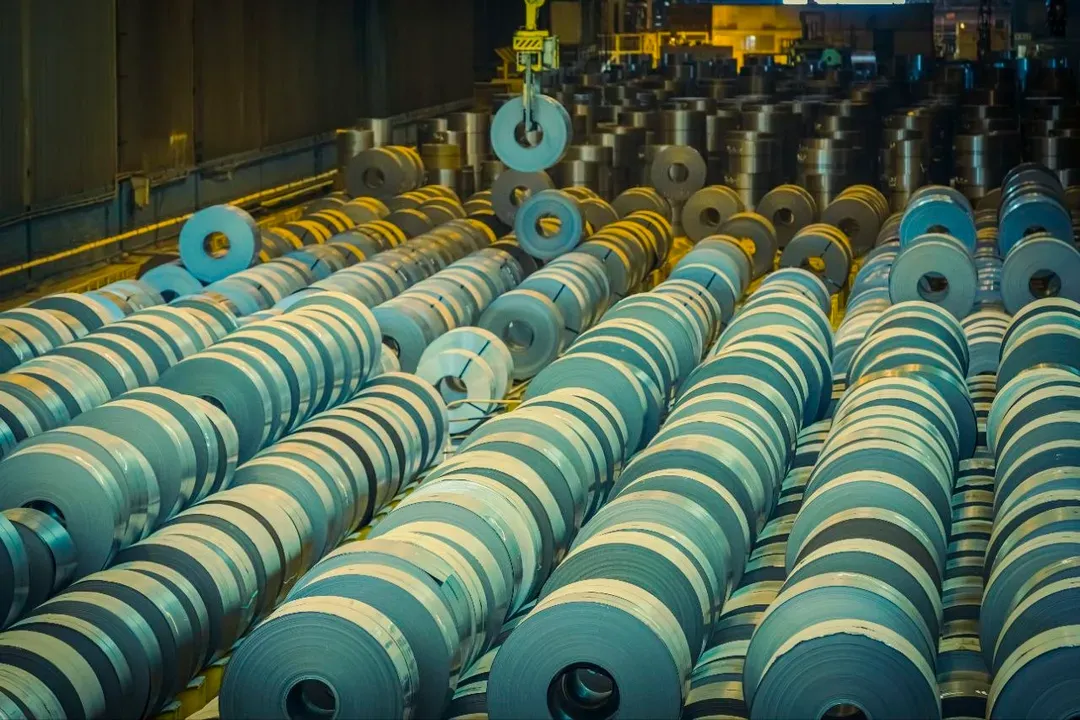
According to Tabnak, citing Fars News Agency: The recent turbulence in the unofficial market for steel sheets, in tandem with the rise in foreign exchange rates, illustrates how a commodity market responds to macroeconomic signals and how ineffective regulatory structures can amplify such pressures. While Mobarakeh Steel, as the dominant market player, has pursued a policy of continued supply and stable base prices on the Iran Mercantile Exchange (IME), sheet prices in the market have become highly distorted and volatile. This situation is the direct outcome of two structural deficiencies in the architecture of the hot-rolled sheet market which, like two blades of a pair of scissors, are pushing competitive forces toward speculation and placing pressure on end consumers.
Leakage of “Behin-Yab Sheets” and the Use of “One-Time Commercial Cards”
The widening gap between prices on the Iran Mercantile Exchange—based on the former NIMA exchange rate or a regulated rate—and prices in the unofficial market, which are based on the open-market exchange rate, has created a large risk-free profit margin, or “arbitrage” opportunity.
This economic incentive causes allocated sheets, instead of being converted into finished products at downstream factories, to leak out of the formal supply chain. The leakage of Behin-Yab-allocated sheets has been recurring for years, yet policymakers and regulatory authorities have still failed to take effective action to address and reform the issue.
From the perspective of industry stakeholders, one-time or rented commercial cards are also a major catalyst behind this distortion. These cards, which are often issued in the names of individuals without a credible commercial track record or established business identity, allow intermediary networks to operate behind an opaque legal layer.
Industry
Using these cards, intermediaries export low-priced, subsidized steel through official customs channels without meaningful volume restrictions. However, because the cardholders have no assets or credible financial standing that can be seized, they can evade their foreign-exchange repatriation obligations.
The result of this dual mechanism is the physical export of a strategic commodity across the country’s borders without the return of the resulting foreign-exchange earnings to the domestic economic cycle. This process creates an artificial shortage and heightened demand pressure in the domestic market.
Supply Asymmetry and the Dual Behavior of Other Producers
In a developed industry, market equilibrium requires all market participants to contribute proportionately to meeting domestic demand. Under the current structure, however, the primary burden of market regulation and compliance with issued directives has fallen on a single supplier: Mobarakeh Steel.
Other rolling mills and sheet producers, contrary to regulatory requirements, refrain from fully meeting their supply obligations on the Iran Mercantile Exchange.
The rationale behind this behavior is the straightforward logic of short-term profit maximization. When the difference between the selling price in the open market and the price on the Iran Mercantile Exchange reaches attractive levels, smaller producers prefer to accept the risk of regulatory penalties, offer only limited quantities through the exchange, and direct the bulk of their production toward the unofficial market.
This asymmetry in compliance with supply obligations channels total market demand toward the only reliable and transparent supply source. As a result, competition among buyers in Mobarakeh Steel’s offerings, despite reductions in the base price and measures to control demand, ultimately leads to higher prices.
The chart above shows that other producers have supplied a total of 133,041 tons of hot-rolled sheet on the Iran Mercantile Exchange so far this year, compared with 911,350 tons supplied by Mobarakeh Steel. In practice, the overwhelming majority of exchange-listed sheet supplies have therefore been provided by Mobarakeh Steel.
Surge in Demand and the Failure of Regulatory Instruments
The combination of these two factors fully explains the current market dynamics. When a significant portion of the commodity leaves the formal production and supply network or is absorbed through one-time commercial cards, while smaller producers refrain from adequate supply, Mobarakeh Steel’s hot-rolled sheet becomes the market’s only secure and dependable source.
Within this flawed structure, fundamental demand forces overpower regulatory policies.
Policymakers and suppliers attempt to cool the market through quantitative restrictions in the Behin-Yab system, adjustments to credit coefficients for purchases, and reductions in the base price for the benefit of consumers. However, buyers—including genuine manufacturers concerned about production-line shutdowns and intermediaries seeking to preserve the value of their capital against currency-driven inflation—are aware of the existing regulatory structure and supply leakages and therefore participate in intense price competition.
By submitting increasingly high bids, they effectively push the final transaction price closer to the open-market rate in order to secure access to the limited available supply.
As long as transparency is not established throughout the value chain—from production to the end consumer—and loopholes involving rented commercial cards and the lack of mandatory proportional supply by competing producers are not closed, any attempt to administratively stabilize the base price will merely intensify competition on the exchange and transfer economic rents to intermediary layers.


