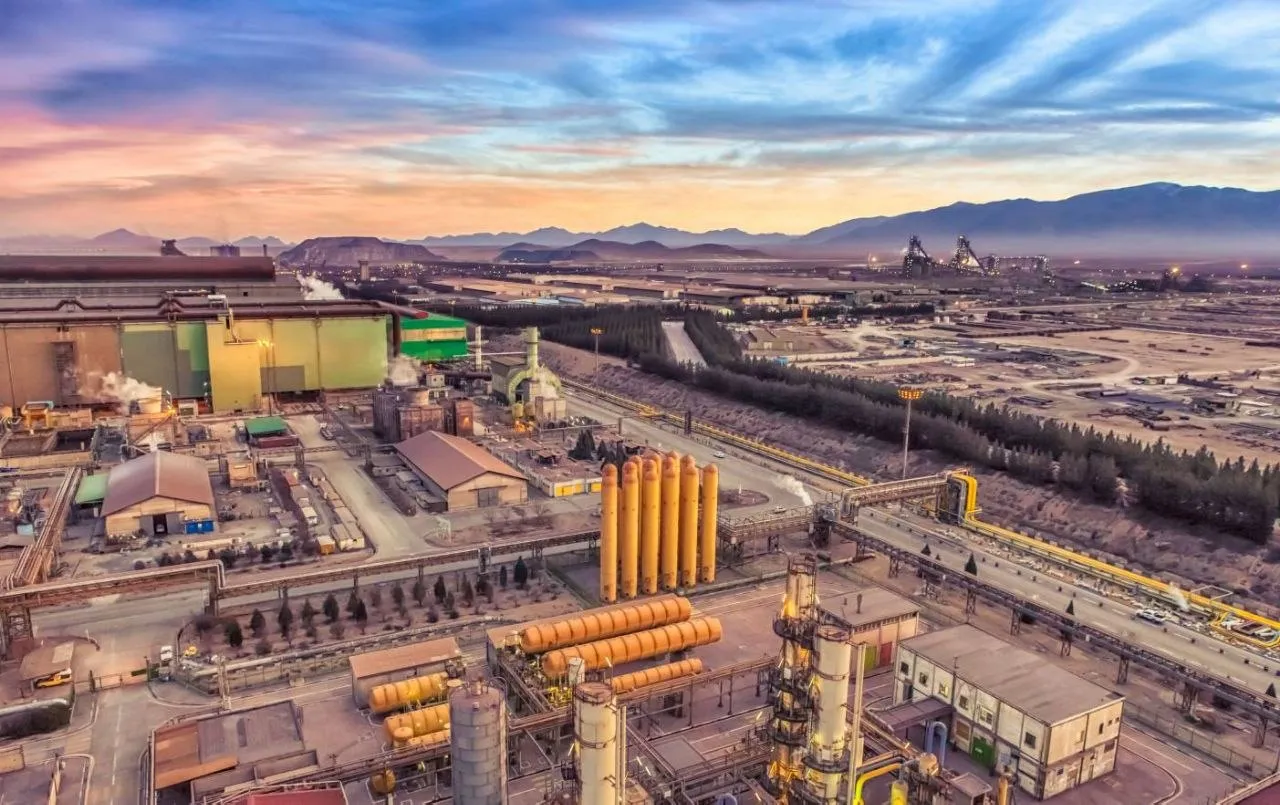
In most instances, a business model shift begins when continuing under the old rules is no longer viable. When costs rise, energy becomes unstable, markets shift, and supply and sales channels no longer resemble the past, the question is not merely increasing production or reducing costs; the issue is that a large enterprise must re-ask itself: Where do we create value from? The year 1404 (2025/2026) was of this exact nature for Mobarakeh Steel; a year in which energy constraints, pricing pressures, logistical disruptions, and unforeseen crises disrupted many familiar equations. However, the group's response was not merely defending the existing model. Signs of a deeper shift in economic and managerial decisions emerged—a transformation where steel is no longer the sole output of furnaces and rolling lines, but rather a collection of fresh resources, technologies, companies, markets, and new opportunities.
"The Insufficiency of Production"
In the traditional model, industrial business logic was simpler: raw materials enter the chain, products are manufactured, and they are sold in the market. But under complex conditions, this very model can become vulnerable. If energy becomes expensive, if pricing mechanisms deprive the manufacturer of flexibility, or even when trade and transportation routes are disrupted, increasing production capacity alone does not guarantee profitability. Over the past year, Mobarakeh Steel sought part of its response outside this logic: redesigning the revenue and cost model. The budget was revised mid-year, and a new mission took shape: discovering pathways to generate new revenues and reduce costs without sacrificing production volume. The result was not merely an austerity program. Around 3.5 thousand billion Tomans (3.5 Toman Trillion / ~35 Trillion Rials) in current operational costs were reduced by altering consumption technologies and optimizing processes, while nearly 10 thousand billion Tomans in new revenue was created through selling accumulated waste and recycling slag. A significant event occurred here: what was once considered waste became part of the value-creation model.
"Returning Waste to the Economic Cycle"
Today's industrial economy no longer ponders solely what to produce; it asks what can be returned back to the value cycle. Accumulated waste from past years and slag, in this view, are no longer the end of the process. They can become the starting point of a fresh economic stream. This shift in perspective appears small, but at the scale of a major steel complex, it bears a different meaning: the boundary between product, cost, and revenue source is redrawn. The same logic is observed in energy management. Once, energy was merely a production input; today, it has turned into a strategic element of the business model. Utilizing data mining to identify non-essential consumption and cutting 800 billion Tomans in energy costs in the first month of project implementation shows that technology here is not exclusively a tool for digitization; it is a tool for changing production economics.
"A New Structure in a Sustainable Economy"
Changing a business model without changing managerial structures will not prove enduring. An organization facing a large ensemble of subsidiary companies loses its agility if it must divide its managerial energy among dozens of units for every decision. Hence, redesigning corporate governance constitutes another part of this change. Moving toward specialized holdings in mining, finance, commerce, as well as water and energy is essentially an effort to convert a large and dispersed group into a set of more specialized, cohesive units. This change is not merely renaming companies or shifting organizational charts. The core matter is bringing decision-making closer to the nature of each business: running mining with mining logic, energy with energy insights, and capital with financial thinking. In this manner, the group can simultaneously pursue multiple tracks without managing them all through a single logic.
"From Product to Opportunity"
Undoubtedly, the most significant sign of business model transformation can be traced to the group's new orientation: developing new businesses, diversifying investments, entering strategic and mining domains, and expanding presence in new markets. This shift does not mean distancing from steel; on the contrary, it means making steel economics more resilient. An enterprise reliant on a single product, a single market, or a single revenue source is more vulnerable to future shocks. However, a group capable of deploying its resources across multiple chains identifies fresh opportunities earlier, adapts its structure accordingly, and subsequently gains greater capacity for longevity. In such a narrative, the development of mining, energy, new businesses, technology, and export markets are not isolated islands separate from steel; they are components of a new architecture.
"A New Model Beyond Numbers"
In a year when many economic equations acted against production, Mobarakeh Steel did not settle for merely preserving what it had. It converted part of its waste into revenue, reduced a portion of costs through data and technology, reorganized its corporate structure, and opened new business pathways. Taken together, these actions outwardly speak of different decision-making logics; but at their core, they share a single narrative: shifting from an enterprise that is purely a producer to an organization that continuously re-adjusts itself with its environment. Perhaps this is the true meaning of transforming a business model: that when the world loses its former shape, the organization does not wait for the world to return to the past—it adapts itself to the changes. On this path, Mobarakeh Steel no longer merely asks: "How much steel should we produce?" The fresh question is: "How can we create greater value from everything at our disposal?" And precisely from this point onward, the enterprise gradually distances itself from being a mere manufacturing plant and turns into an economic ecosystem—an ecosystem designed to generate not just products, but opportunities.


