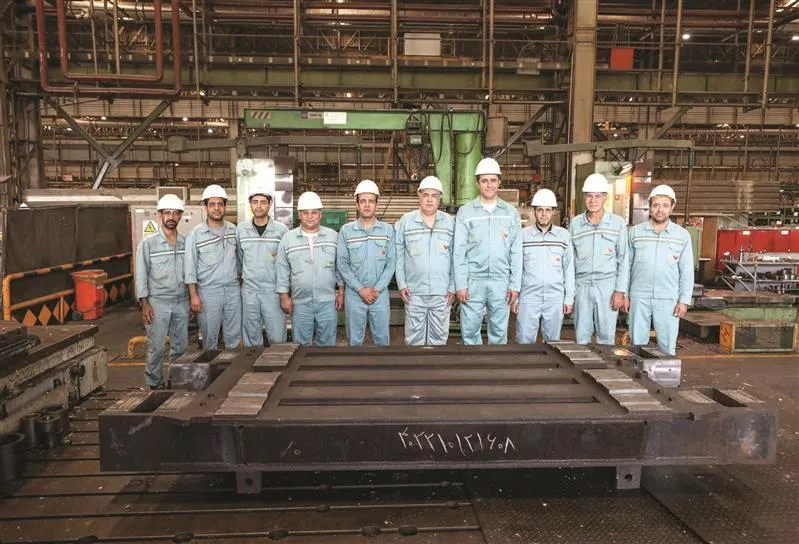
Mosib Safian Beldaji, Head of the Machine Tool Workshop at the Central Workshop and the person in charge of the project, confirmed the news in an interview with a Steel correspondent, stating: “Given the importance of implementing the strategy of management and maximum cost reduction, as well as making full use of internal capabilities, we decided to undertake this project within Mobarakeh Steel itself, relying on the knowledge and expertise of our colleagues, despite the heavy workload at the Central Workshop.”
He explained that the segment top frames are among the extremely heavy and critical components of the continuous casting machines at Mobarakeh Steel’s production site, adding: “Due to the scheduled shutdowns for modernization of the caster, these components were urgently required, and their timely availability played an important role in preventing interruptions to production.”
Safian briefly explained the role of these components in the production line, stating: “The top frames essentially form the upper section of the roller-guiding path within the caster segments. Their primary function is to withstand heavy loads and ensure the proper and deviation-free guidance of the hot slab throughout the production process.”
Describing the fabrication process, he said: “To execute this project, detailed fabrication drawings were first prepared, followed by the fabrication and welding of the structural components at the Structural Fabrication Workshop. Subsequently, to prevent unwanted deformation and ensure dimensional stability, stress-relief heat treatment was performed on the components.”
The Head of the Machine Tool Workshop emphasized the sensitivity of the final stages of the work, stating: “Machining components of this size requires the development of a precise machining strategy. From designing suitable fixtures to secure the component and minimize vibration on the machine table, to selecting optimal cutting tools and programming the CNC system, every aspect was carried out with great precision to ensure extremely tight and accurate geometric tolerances on the required surfaces in accordance with the stringent standards applicable to casting equipment.”
Overcoming machining challenges using a large CNC gantry milling machine
Alireza Rahimi, a Machine Tool Specialist, also discussed the technical challenges and significance of the project, stating: “The most important challenge in machining these components was their extremely large dimensions combined with the requirement for very high machining accuracy. According to the dimensions specified in the technical drawings, we were dealing with a component more than 2.2 meters long and approximately 1.7 meters wide.”
He added: “To perform the machining operations accurately and achieve the required quality, a CNC gantry milling machine was used. This heavy-duty, high-precision machine enabled us to machine several different geometric features—including bearing seats, bearing holes, and mating surfaces—in a single setup and clamping on the machine table.”
“Performing multiple machining operations in a single setup not only significantly reduces production time but also prevents accumulated errors caused by repeated unclamping and reclamping. It also ensures the required coaxiality and parallelism for final assembly on the continuous casting machine.”
In conclusion, the project manager expressed his appreciation for the support provided by the Central Workshop management, the cooperation of the engineering teams and the heads of the Fabrication and Structural Fabrication Workshops, as well as the efforts of all Machine Tool technicians and operators who played a key role in the accurate and timely execution of this critical project.


